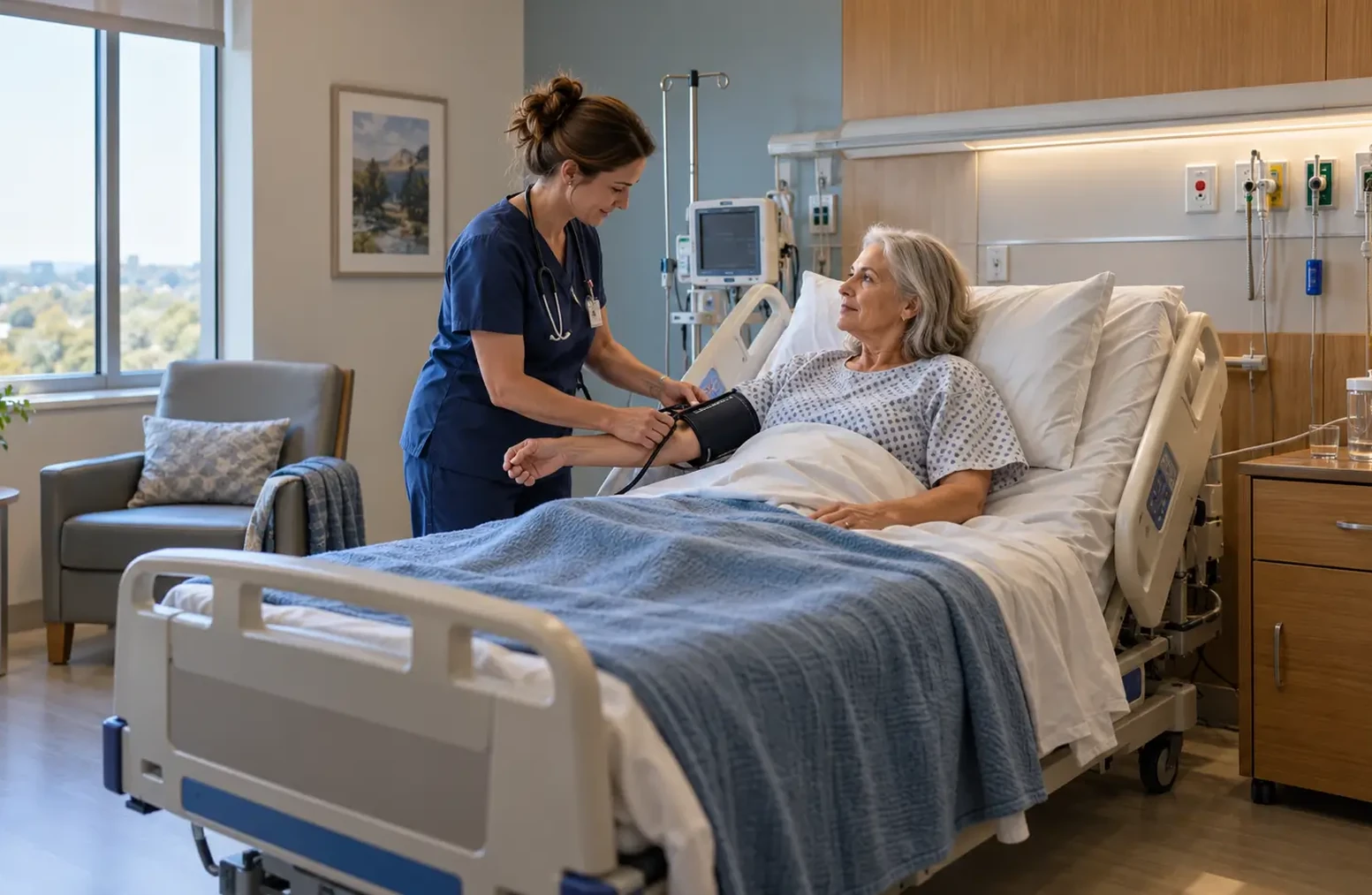
The difference between inpatient and outpatient care is whether you are formally admitted as an inpatient. Inpatient care involves admission for hospital-based treatment. Outpatient care includes appointments, tests, procedures, and treatment without inpatient admission. An overnight stay does not automatically make you an inpatient.
This distinction matters because your hospital status can affect insurance coverage, medical bills, and arrangements after discharge.
Understanding both types of care can also help you prepare for surgery, rehabilitation, or mental health treatment.
What Is the Difference Between Inpatient and Outpatient Care?
Inpatient and outpatient describe how care is delivered and classified. They do not, by themselves, explain your diagnosis or how serious your condition is.
Inpatients receive care after formal admission. Outpatients receive services without inpatient admission, whether at a clinic, surgery center, or hospital.
| What to compare | Inpatient care | Outpatient care |
| Admission | Formal inpatient admission | No inpatient admission |
| Typical arrangement | Hospital-based treatment, often involving an overnight stay | Appointments, tests, procedures, or treatment visits |
| Monitoring | Hospital monitoring appropriate to the condition | Monitoring appropriate to the service or procedure |
| Overnight stay | Common | Possible, including during hospital observation |
| Recovery | Initial recovery may occur in the hospital | Often continues at home after treatment |
| Examples | Treatment requiring inpatient admission | Clinic consultations, imaging, outpatient surgery, and observation |
| Insurance | Inpatient coverage rules may apply | Outpatient coverage rules may apply |
The same condition or procedure may involve different care arrangements for different patients. Your clinical needs and treatment plan determine what is appropriate.
What Is Inpatient Care?
Inpatient care is treatment received after formal admission to a hospital or another inpatient facility. It often involves an overnight stay and access to hospital staff, treatment, and monitoring.
Admission may be planned, such as before certain operations. It can also follow an emergency assessment when further hospital care is necessary.
During an inpatient stay, your team may provide medication, tests, procedures, nursing care, and discharge planning.
Examples of Inpatient Care
Depending on the patient’s needs, inpatient care may include:
- Treatment for a serious illness requiring hospital admission.
- Recovery after selected major operations.
- Care following significant injuries.
- Treatment for certain heart or breathing conditions.
- Inpatient psychiatric treatment.
- Inpatient rehabilitation.
These examples are not automatic admission rules. A diagnosis alone does not determine the setting for every patient.
What Happens During an Inpatient Stay?
Your care team reviews your condition, provides treatment, and monitors progress.
You may see several professionals, including physicians, nurses, therapists, and case managers. Their roles depend on your needs.
Before discharge, the team should explain your medications, follow-up appointments, recovery instructions, and symptoms requiring further help.
What Is Outpatient Care?
Outpatient care is medical assessment or treatment provided without inpatient admission. It can occur in a physician’s office, clinic, hospital department, or ambulatory surgery center.
Many outpatient visits end the same day. However, same-day departure is not the complete definition because some hospital outpatients remain overnight.
Outpatient treatment can be a single appointment or a series of visits over time.

Examples of Outpatient Care
Common examples include:
- Primary care and specialist consultations.
- Laboratory tests.
- X-rays, CT scans, and MRI appointments.
- Selected surgical procedures.
- Physical and occupational therapy.
- Mental health counseling.
- Follow-up appointments after hospitalization.
Outpatient care can involve complex or important treatment. The term does not mean that a condition is minor.
Is Ambulatory Care the Same as Outpatient Care?
“Ambulatory care” commonly refers to services provided without inpatient admission.
The term describes the care arrangement. It does not mean that every patient receiving the service can walk without assistance.
Can You Stay Overnight and Still Be an Outpatient?
Yes. You can spend the night in a hospital and remain an outpatient. Hospital observation is an important example.
Observation services allow the team to monitor and reassess you while deciding whether inpatient admission or discharge is appropriate.
Under Medicare, observation services are classified as outpatient care. Being in a hospital bed overnight does not change that classification by itself.
What Is Observation Status?
Observation status describes hospital outpatient services used for assessment, monitoring, and treatment while the next step is determined.
Your status can change if you are subsequently admitted as an inpatient. Ask the hospital team to explain your current classification.
| Hospital situation | What it means |
| Emergency assessment without inpatient admission | Outpatient hospital care |
| Overnight monitoring under observation | Outpatient status may continue |
| Formal inpatient admission | Inpatient status begins |
| Discharge after observation | The stay may remain classified as outpatient |
Ask directly, “Am I currently an inpatient or an outpatient receiving observation services?”
Is an Emergency Room Visit Inpatient or Outpatient?
An emergency room visit is generally outpatient hospital care until formal inpatient admission occurs.
After assessment, you may go home, receive observation services, or be admitted for further treatment.
The seriousness of the emergency does not automatically establish inpatient status.
For severe symptoms or a life-threatening emergency, seek help immediately. The RMCHCS Emergency Room provides emergency assessment. Call 911 for a life-threatening emergency.
Inpatient vs Outpatient Surgery
Surgery can be performed through either inpatient or outpatient care. The procedure, your overall health, and expected recovery needs influence the plan.
Outpatient surgery usually involves discharge after the team confirms that you meet the appropriate recovery requirements.
Inpatient surgery involves formal admission and hospital care before or after the operation.
What Determines the Surgical Setting?
Your team may consider:
- The type and complexity of the procedure.
- Anesthesia and recovery requirements.
- Existing medical conditions.
- The need for monitoring or additional treatment.
- Mobility and self-care needs.
- Safe discharge arrangements.
Some procedures can be outpatient for one person and inpatient for another.
Can Outpatient Surgery Lead to Admission?
Yes. A planned outpatient procedure may require additional observation or inpatient admission if your clinical needs change.
Ask your surgical team what would happen if you need to stay longer than expected.
Mental Health Outpatient vs Inpatient Care
The mental health outpatient vs inpatient distinction concerns the treatment setting and level of support required. It is not a judgment about the person or their diagnosis.
Outpatient mental healthcare allows someone to attend appointments while continuing to live outside the facility.
Inpatient psychiatric care provides treatment within a hospital following admission. It may be needed when symptoms or safety concerns require hospital-level care.
A qualified clinician should assess which setting is appropriate.
When Outpatient Mental Healthcare May Be Appropriate
Outpatient care may suit someone whose needs can be managed safely through scheduled appointments and an appropriate support plan.
Services may include assessment, psychotherapy, medication management, and follow-up.
The frequency of appointments varies according to the individual’s needs.
When Inpatient Mental Healthcare May Be Needed
Inpatient care may be considered when someone requires hospital-level assessment, stabilization, monitoring, or treatment.
Decisions consider current symptoms, safety, medical needs, and available support.
For immediate danger, suspected overdose, or another life-threatening emergency, call 911.
Outpatient vs Inpatient Mental Health Services
Both outpatient and inpatient mental health services can include assessment, medication, and therapy. The main differences involve where treatment occurs and how support is delivered.
| Service feature | Outpatient mental healthcare | Inpatient mental healthcare |
| Living arrangements | Patient generally continues living at home | Patient stays in the hospital during admission |
| Treatment contact | Scheduled appointments or structured programs | Hospital-based treatment and monitoring |
| Common components | Assessment, counseling, medication management | Assessment, stabilization, medication, and therapeutic support |
| Daily routine | Treatment is arranged around life outside the facility | Activities follow the hospital’s treatment schedule |
| Next steps | Ongoing review and adjustment | Discharge planning and follow-up care |
A person may move between settings as their needs change.
What About Intensive Outpatient Programs?
An intensive outpatient program, or IOP, provides structured treatment without inpatient admission.
A partial hospitalization program, or PHP, is another structured outpatient option. Despite the word “hospitalization,” it does not mean inpatient admission.
These programs have specific eligibility and service arrangements. They should not be assumed to be available at every clinic.
To explore local options, review RMCHCS behavioral health services and ask which services match your needs.
Outpatient vs Inpatient Therapy
Outpatient vs inpatient therapy can refer to physical rehabilitation, occupational therapy, or mental health treatment. The meaning depends on the service being discussed.
The setting affects how therapy fits into your overall care plan.
Physical and Occupational Therapy
During hospitalization, therapy may assess mobility, daily activities, and support needed for discharge.
Outpatient rehabilitation usually involves attending scheduled sessions while living at home.
A patient may receive inpatient therapy first and continue outpatient treatment later.
| Therapy consideration | Inpatient setting | Outpatient setting |
| Location | Hospital or appropriate inpatient facility | Clinic or outpatient department |
| Main context | Therapy within a broader admission or rehabilitation program | Therapy delivered through scheduled visits |
| Daily support | Depends on the admission and facility | Relies on arrangements outside appointments |
| Treatment goals | Individualized to current needs | Individualized to recovery and daily functioning |
An acute hospital therapy consultation is not the same as admission to a dedicated inpatient rehabilitation facility.
Mental Health Therapy
Psychotherapy may be provided in both settings.
Inpatient therapy forms part of hospital treatment. Outpatient therapy occurs through scheduled individual, family, or group sessions.
The appropriate approach depends on assessment and treatment goals.
Inpatient vs Outpatient Costs and Insurance
Hospital status can affect coverage and patient costs, but it does not determine the entire bill.
The service, facility, clinicians, insurance benefits, and treatment needs all matter. Inpatient care often involves additional hospital resources, but outpatient care is not automatically inexpensive.
Costs to Ask About

| Cost term | What it means |
| Deductible | Amount you pay before certain insurance benefits begin |
| Copayment | A fixed payment for a covered service |
| Coinsurance | Your percentage of a covered charge |
| Facility charge | A charge associated with the treatment location |
| Professional charge | A charge for a clinician’s services |
| Network status | Whether the provider participates in your plan |
You may receive separate bills from the hospital, surgeon, anesthesiology team, or other providers.
For planned care, ask what an estimate includes and which services may be billed separately.
How Medicare Treats Hospital Status
Under Original Medicare, Part A generally covers eligible inpatient hospital services. Part B covers eligible outpatient hospital services and many clinician services, including services during inpatient stays.
Observation is outpatient care under Medicare. Status may also affect eligibility for certain care after hospitalization.
Medicare Advantage plans can have different cost-sharing and coverage arrangements. Check your specific plan.
Do not assume that an overnight stay is covered as inpatient care. Confirm your status with the hospital.
Who Decides Between Inpatient and Outpatient Care?
The healthcare team determines the appropriate care arrangement through clinical assessment and applicable admission criteria. Insurance coverage rules also affect payment.
The decision may consider:
- Symptoms and clinical findings.
- Need for hospital treatment or monitoring.
- Expected course of illness or recovery.
- Response to initial treatment.
- Relevant medical conditions.
- Safe discharge needs.
Patients can ask questions and discuss concerns, but hospital status is not simply a preference selected for convenience.
How Inpatient and Outpatient Care Work Together
Inpatient and outpatient care are often different stages of the same treatment journey.
For example, a patient may have:
- An outpatient consultation.
- Diagnostic testing.
- A procedure or hospital admission.
- Discharge with instructions.
- Outpatient follow-up or rehabilitation.
Clear communication between services helps patients understand medication changes, appointments, and recovery goals.
Keep copies of discharge instructions and bring an updated medication list to follow-up visits.

Questions to Ask Before Receiving Care
For planned treatment, use this checklist to understand both the medical plan and practical arrangements.
| Question | Why it matters |
| Will this be inpatient, outpatient, or observation care? | Clarifies expected status |
| Why is this setting appropriate? | Explains the clinical plan |
| Could the status or discharge plan change? | Helps prepare for unexpected needs |
| What does my insurance cover? | Identifies plan-specific requirements |
| Will I receive separate bills? | Clarifies potential charges |
| Do I need transport or help at home? | Supports safe discharge |
| What follow-up is required? | Connects treatment with recovery |
| Who should I contact with problems? | Provides a clear point of contact |
During a hospital stay, ask whether your status has changed.
Preparing for Outpatient Treatment or Hospital Admission
Preparation depends on the service. Follow the instructions provided by your care team.
Useful items may include:
- Identification and insurance information.
- A current medication and allergy list.
- Relevant medical records.
- Required referrals or authorizations.
- Contact details for someone supporting you.
- Questions about treatment and recovery.
For procedures involving sedation or anesthesia, follow the team’s transport, fasting, and supervision instructions.
Do not stop medication or change doses unless your clinician tells you to do so.
Frequently Asked Questions
Does Outpatient Mean You Go Home the Same Day?
Often, but not always. Some hospital outpatients stay overnight for observation or other appropriate care without inpatient admission.
Is Inpatient Care Always More Serious?
Inpatient care involves formal admission and hospital-level needs. However, outpatient status does not mean a condition is minor.
Is Rehabilitation Inpatient or Outpatient?
It can be either. The setting depends on the type of rehabilitation and the person’s clinical and functional needs.
Is an IOP Inpatient or Outpatient?
An intensive outpatient program is outpatient treatment. Patients attend structured services without inpatient admission.
Is Acute Care Inpatient or Outpatient?
“Acute” describes care for an illness or injury requiring timely attention. It does not, by itself, establish admission status.
Can Hospital Status Change?
Yes. A patient may move from emergency or observation services to inpatient admission when appropriate. Ask the team to explain any change.
Is Outpatient Care Always Cheaper?
No. Costs depend on the services, facility, insurance coverage, and individual circumstances. Ask for a service-specific estimate.
Understanding Your Care at RMCHCS
The most useful question is not simply whether you will stay overnight. Ask what your care plan involves and whether you are formally admitted as an inpatient.
For non-emergency care, explore RMCHCS services to learn about available hospital, clinic, diagnostic, and specialty services.
Before planned treatment, confirm your care setting, insurance requirements, recovery arrangements, and follow-up plan.